
The rich text element allows you to create and format headings, paragraphs, blockquotes, images, and video all in one place instead of having to add and format them individually. Just double-click and easily create content.
A rich text element can be used with static or dynamic content. For static content, just drop it into any page and begin editing. For dynamic content, add a rich text field to any collection and then connect a rich text element to that field in the settings panel. Voila!
Headings, paragraphs, blockquotes, figures, images, and figure captions can all be styled after a class is added to the rich text element using the "When inside of" nested selector system.
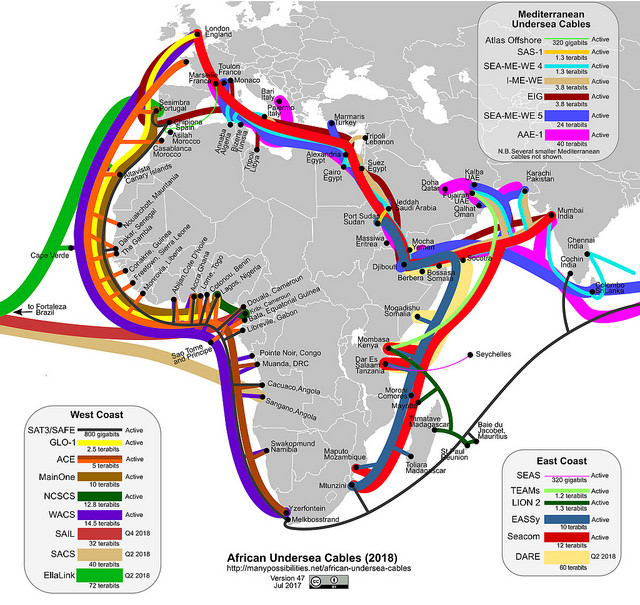
GSMA have released their 2017 Mobile Economy: Sub-Saharan Africa study which has put unique mobile subscriptions in Sub-Saharan Africa at a penetration rate of 43 percent. They are expected to grow to over 500,000,000 unique mobile subscriptions in the region by 2020, at a rate that is 50 percent higher than the global average.I've said before that this increased connectivity can be attributed in part to two things; the democratisation of the smartphone thanks to cheaper mobile phones from Asian manufacturers, and the lower cost of data driven by the migration of wireless to fibre optic connectivity in the region. A great resource is Steve Song's undersea cables map, which was recently updated.
Reaching connected Africans is no walk in the park. Increasing government and regulatory scrutiny, as well as a lack of expansion opportunities in sub-Saharan Africa, are making it harder for multinational operators such as Vodafone (UK), Orange (France) and Bharti Airtel (India) to grow. Here in Kenya, Vodafone recently transferred most of its $3.6 billion stake in Safaricom to majority-owned South African unit Vodacom Group Ltd, while French operator Orange recently offloaded 70 percent of its stake in Telkom Kenya to a private equity firm.
What to Sip (<30 Sec read)
“The mere presence of your smartphone around you reduces brain power, even if the device is turned off.”
Adrian Ward, Researcher
The professor and co-authors determined in a study of over 800 people, that mobile phones greatly reduced cognitive capacity when in the vicinity and could even lead to brain damage in children.
A new study on Twitter sheds light on how the social media platform can be hijacked by bots to spread political disinformation during election campaigns, with the potential to reach a critical mass large enough to dominate the public discourse and alter public opinion. Some of these bots were used to spread propaganda against Emmanuel Macron during the recent French presidential election and even spread misinformation in favour of Donald Trump last year.
Mobile money and the stats leading this newsletter are why pundits called Africa 'Silicon Savannah' years ago. This beckoned a promise of a 'leapfrogging' effect to disrupt telephony and society with innovation. 10 years into M-Pesa's evolution, the rest of the continent is yet to truly live up to this. Kenyan Harvard Kennedy School professor Calestous Juma puts a strong argument in The Misplaced Promise of Africa’s Mobile Revolution. He argues that innovation policy is sorely lacking, Africans online remain consumers and not producers (of technology) and that infrastructure & industrialisation are missing to spark the manufacturing-based economies needed to truly leapfrog. There is still far to go.
That's it for now, here’s wishing an unplugged weekend. My team and I are excited to be launching something on Kenyan Internet Stats and your sneak peek is below. As a newsletter subscriber, you'll see it here first. Odipo Dev published an update
to the fake news piece we revealed last week.
I'm still collecting feedback on your training, learning and skills needs for the year. Haven't taken the two minutes to fill in my form yet? The partners, team at ISA and I have opted to postpone our training to after Kenya's August 8th general election. I'll be in touch then.
I appreciate those of you who have written me to say the newsletter is too long or a bit dense, I continue to look at the data and other ways to make this useful to you. You can always let me know how to make this better for you. Special thanks to the team at African innovation magazine Ogojiii for giving our newsletter a plug a few weeks ago.
Yours,
Mark & Team Nendo