
New: How Kenyans use AI. Our 2026 survey of 1,161 AI users in 18 counties
At a recent gathering convened by Search for Common Ground in Nairobi, participants were given a piece of paper and asked to write down the word peace.
Then they were asked to tear it into smaller and smaller pieces.
The final instruction was simple: put it back together exactly as it had been.
It could not be done.
The pieces could be rearranged and brought close together, but the original sheet could not be restored without cracks.
The exercise offered a simple metaphor for a much more complicated challenge facing Kenya as the country moves towards the 2027 General Election: preventing the breakdown of trust is considerably easier than rebuilding it afterwards.
But the conversations that followed pointed to something else.
Kenya does not necessarily have a shortage of warning signs.
Communities often see tension building. Young people hear rumours before they become headlines. Journalists notice shifts in political rhetoric. Local actors recognise when familiar grievances begin taking on new meaning. Online, narratives can change direction within hours.
The harder question is whether those signals can be identified, interpreted, verified and moved through trusted systems quickly enough to change what happens next.
That gap between hearing and acting sits at the heart of early warning.
It is also where social listening becomes particularly relevant.
Search for Common Ground is working with youth, community actors, institutions and peacebuilding networks to strengthen early-warning and early-response capacity as Kenya approaches 2027. As part of this work, Nendo is supporting the digital social-listening and analysis layer: examining public online conversations for changing narratives, emerging risks and signals that may warrant deeper investigation.
The opportunity is not simply to collect more information.
It is to understand what matters before it becomes impossible to ignore.
This challenge is unfolding within a rapidly changing information environment.
DataReportal estimates that Kenya had 23.9 million social-media user identities in October 2026, equivalent to around 40.6% of the population. The figure should not be interpreted as 23.9 million unique people, but it illustrates the scale of the digital public sphere.
At the same time, a substantial share of the country remains outside the online spaces being measured.
That tension matters.
A significant part of Kenya’s political conversation is digitally visible.
A significant part is not.
Social listening can therefore reveal signals at a scale and speed that conventional research often cannot. But it cannot stand in for what is happening in communities.
The useful intelligence sits in the relationship between the two.
One of the clearest findings presented during the gathering concerned the distance between recognising danger and believing that reporting it will lead to anything useful.
In the baseline research, 91.2% of participants using the printed tool said they could recognise rising tension as elections approached.
That is a strong starting point.
The difficulty emerged further down the chain.
57% said they did not feel safe providing information, while 53.3% did not trust the response that would follow.
Participants also raised fears about what might happen after reporting, whether reporting could place them in danger and whether anything would change after information had been shared.
This begins to resemble a funnel of trust.
At the widest point, people can recognise that something is changing.
Further down, the questions become harder.
Where should the information go?
Will reporting create personal risk?
Will the information be believed?
Will somebody respond?
And will the person raising the concern ever know what happened afterwards?
The problem is therefore not simply one of awareness.
It is about creating a credible chain between:
detection, verification, reporting, protection, response and feedback.
This trust challenge extends beyond the research presented in the room. Afrobarometer’s 2024 Kenya survey found that only 36% of Kenyans said they trusted the police “somewhat” or “a lot”, falling to 29% among urban respondents.
If people can identify risk but do not trust the systems responsible for receiving or acting on that information, early warning becomes considerably weaker.
One phrase shared during the discussions captured this succinctly:
Peace moves only at the speed of trust.
The same challenge becomes even more complicated online.
A misleading video, inflammatory statement or allegation about a political or ethnic group can begin as a relatively small conversation.
It can then travel through TikTok comments, Facebook groups, X conversations and WhatsApp networks.
It can be clipped, reframed, joked about, politicised or stripped of its original context.
Eventually, a claim can acquire something more consequential than reach:
belief.
The boundary between online and offline risk is therefore becoming increasingly difficult to draw.
An offline grievance can be amplified online.
A digital rumour can change how people interpret something happening in their neighbourhood.
Political criticism can acquire an ethnic frame.
Humour can normalise hostility.
Repeated misinformation can create expectations about what another community intends to do.
And online narratives can influence mobilisation offline.
But the same platforms are also enormous listening environments.
People reveal anxieties and grievances online that may never emerge in a formal consultation.
They argue in comment sections.
They use slang and coded language.
They make jokes.
They circulate screenshots.
They react to speeches.
They speculate.
They organise.
They disagree.
For researchers and peacebuilding actors, these conversations provide another source of evidence about how events are being interpreted in real time.
The difficulty is knowing how to read them.
This is where volume can become deceptive.
During one of Nendo’s monitoring periods between June and September 2026, the social-listening system captured 1.22 million mentions, an increase of 11.2% compared with the preceding period.
Yet over the same period, the visible author base fell 18.3% to approximately 158,900 unique authors.
The largest conversation spike reached approximately 69,200 mentions.
That produces an important analytical warning:
More conversation does not necessarily mean more people are talking.
Higher volume may represent broader public attention.
But it could also reflect one event concentrating conversation, highly active accounts posting repeatedly, influential actors amplifying a narrative, or a relatively small group becoming significantly louder.
That is why a spike on a dashboard cannot, by itself, be considered an early-warning signal.
Context has to give it meaning.
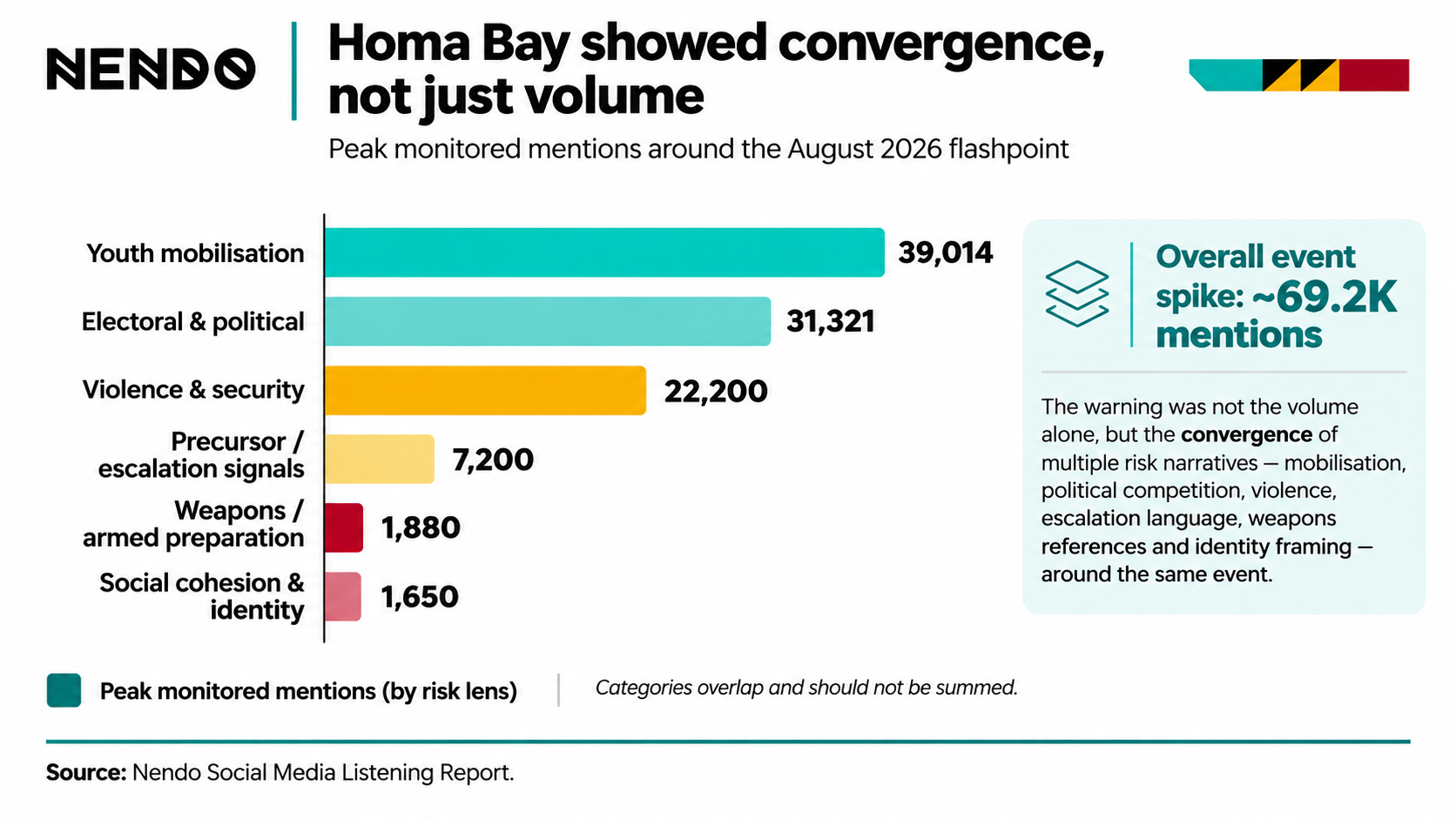
The clearest illustration came from Homa Bay in August.
The broader event generated an online conversation spike of roughly 69,200 mentions.
But the headline figure was not the most important finding.
Underneath it, several different forms of conversation were peaking around the same event.
Youth mobilisation reached roughly 39,000 mentions.
Electoral and political conversation reached about 31,300.
Violence and security conversation reached 22,200.
At smaller volumes — but with potentially greater significance for escalation — the monitoring also picked up approximately 7,200 precursor and escalation signals, 1,880 weapons or armed-preparation references, and 1,650 social-cohesion and identity mentions.
These categories overlap and should not be added together.
Their value is in what they reveal when read together:
multiple risk narratives were converging around the same event.
The 69,000-mention spike was not, on its own, the warning.
The warning was that mobilisation, political competition, violence, escalation language, weapons references and identity framing were moving at the same time.
This is where social listening becomes considerably more useful than monitoring.
The task is no longer simply to ask:
How much conversation occurred?
It becomes:
What else is happening around that conversation?
A useful early-warning system also needs to know when not to raise the alarm.
Nairobi provided that contrast in September.
Another major mobilisation moment generated roughly 29,000 mentions.
Yet the surrounding narrative looked different.
Where Homa Bay combined violence narratives, weapons references, political blame and identity tension, the Nairobi mobilisation was associated with positive energy, political optimism and joy — without an equivalent violence signal.
Positive sentiment peaked at 5,980 mentions, while joy reached 8,120.
That comparison is important.
Mobilisation itself is not necessarily dangerous.
Neither is political anger.
Neither is criticism of government.
Neither is a trending hashtag.
A large online conversation can be politically significant without representing heightened conflict risk.
The analytical question is what is converging around it.
That distinction is why early-warning systems need analysts, not just alerts.
Standard monitoring can show that conversation is increasing.
Analysis has to determine why.
Is the narrative new, or has it appeared before?
Has the language become more hostile or exclusionary?
Is it moving from one platform to another?
Who introduced the narrative?
Who is amplifying it?
Is a national political issue being transformed into a local community grievance?
Is a local grievance being nationalised?
Are influential voices driving the conversation, or simply reacting to it?
Are references to particular communities, locations or actions beginning to appear?
And perhaps most importantly:
What requires escalation, what needs verification and what is simply noise?
Nendo’s monitoring has already demonstrated why this distinction matters. Early-warning queries can produce both useful signals and false positives.
A word such as attack, fire, weapon or kill can appear in a political-risk context.
It can also appear in a football discussion, a joke, a news headline or an unrelated conversation.
Technology can detect the word.
The harder task is interpreting its meaning.
That is why analyst review, contextual interpretation and verification against what is happening on the ground remain essential.
That is also the difference between social listening as a dashboard and social listening as intelligence.
One tells decision-makers what is being said.
The other helps explain what it means, why it matters and what should be watched next.
The baseline research also revealed how complicated young people’s experience of digital spaces can be.
72% of participants said they had seen hate speech drive tension, while 67% reported self-censoring because of harassment.
At the same time, digital spaces were identified as opportunities for citizen expression, documentation, rapid reporting, information sharing and youth-led early warning.
That contradiction matters.
The same platforms capable of amplifying inflammatory narratives can also expose them.
The same networks through which misinformation travels can document abuse.
The same tools used for political mobilisation can also strengthen civic participation.
Digital safety is therefore not separate from peacebuilding.
It is becoming part of it.
This also explains why social listening cannot depend on formal keywords alone.
Nendo’s monitoring methodology includes an emerging-language layer covering slang, euphemisms, coded speech, hashtags, misspellings and local-language terminology, reviewed as conversations evolve.
Risk rarely announces itself using perfectly written keywords.
Language changes.
So must the listening.
Economic vulnerability also emerged strongly from the baseline research.
93% of respondents using the printed tool said unemployment and economic hardship make young people vulnerable to political manipulation.
National research points in the same direction.
Afrobarometer found that 43% of Kenyan youth aged 18–35 were unemployed and looking for work, despite 80% having secondary or post-secondary education.
Economic pressure can make political inducements, patronage and recruitment more consequential.
But treating young people only through the language of vulnerability misses an equally important part of the picture.
The discussions repeatedly positioned young people not simply as people who might be mobilised, but as people already capable of recognising risk, interpreting their communities and participating in prevention.
In the baseline, 75% wanted a direct role in policy and budget decisions, while 69% wanted to see their contributions reflected in final decisions.
That led to one of the more useful questions raised during the gathering.
Instead of asking only:
Why do some young people participate in violence?
What happens when the question becomes:
Why are most young people peaceful?
The change in framing matters.
If young people are treated mainly as a security risk, early-warning systems will naturally search for signs of dangerous behaviour.
If they are recognised as actors within their own communities, analysis can also identify the factors preventing escalation:
trusted relationships,
credible local voices,
peer networks,
community dialogue,
informal mediation,
and the everyday decisions people make not to participate in violence.
Effective early warning should therefore detect more than risk.
It should also understand resilience.
Detection is only half the system.
A sophisticated monitoring dashboard means very little if nobody knows what should happen when an alert appears.
A community member needs to know where information should go.
A youth monitor needs to know whether an issue requires normal referral or urgent escalation.
Institutions need enough context to judge whether information is credible.
The person reporting it needs reasonable protection.
And communities need feedback.
Otherwise, information moves upwards while nothing visible comes back down.
The wider monitoring approach discussed by Search for Common Ground reflects that need for connection.
Signals can begin with community observation and structured reporting. Digital social listening can provide another layer. Stakeholder and early-warning structures add institutional context. Verification and triangulation help establish whether a signal is credible before risk assessment and referral determine what should happen next.
Nendo’s social-listening work sits inside that broader process.
Its purpose is not to look at an online conversation and declare that a crisis exists.
Its role is to help answer a more useful set of questions:
What is changing?
Why is it changing?
Who is shaping it?
What requires verification?
Does it matter offline?
And who needs to know while there is still time to act?
Kenya’s political conversation will almost certainly become louder as 2027 approaches.
There will be more speeches.
More campaigns.
More hashtags.
More memes.
More misinformation.
More political commentary.
More anger.
More humour.
More attempts to influence how Kenyans interpret what is happening around them.
The challenge will not be finding information.
There will be too much of it.
The challenge will be distinguishing noise from signal.
Sometimes the earliest indication of changing conditions will not arrive in an official report.
It may be a phrase appearing repeatedly beneath TikTok videos.
A rumour beginning to move between Facebook groups.
A meme whose meaning has shifted.
A national political statement suddenly being interpreted through an ethnic or class lens.
An unusual cluster of accounts repeating the same allegation.
Or a small local conversation that appears insignificant nationally but carries very different meaning in the community where it originated.
None of these automatically means conflict is coming.
They are signals.
Signals require interpretation.
And interpretation requires context.
The future of effective early warning therefore does not lie simply in collecting more data.
It lies in combining better listening, human interpretation, trusted reporting pathways, ground verification, local context and institutions capable of responding while the information can still change what happens next.
That returns the conversation to the torn piece of paper.
Once trust has been broken, putting the pieces together is slow and difficult.
The better opportunity is to recognise what is changing before the tear happens.
Listen while the paper is still whole.


